Physical Address
304 North Cardinal St.
Dorchester Center, MA 02124
Physical Address
304 North Cardinal St.
Dorchester Center, MA 02124


When Secretary Bessent announced, last September, a negotiated $20 billion swap line for Argentina, along with a promise to do “whatever is needed” to stabilise the country, most analysts and think tanks stared in disbelief, even denial. Argentina had spent decades perfecting a reputation for economic mismanagement. Dismissed as a marginal actor in the global chessboard — too far from conflict zones and too unreliable to serve as a credible ally — many pundits interpreted the move as just another impulsive act of an erratic Trump administration. After the release of the latest National Security Strategy, it should now start to make sense.
The document defines a U.S. strategy built on a return to national sovereignty, economic independence, and peace through strength. It rejects expansive, idealistic global agendas and insists that foreign policy must be grounded in clearly defined national interests. It emphasises cultural cohesion, industrial revival, strong traditional families and a confident national identity as foundations of long-term security and global power.
Geographically, the strategy reorients U.S. focus toward the Western Hemisphere, reviving a modern version of the Monroe Doctrine to prevent foreign influence. Under the so-called “Trump’s Corollary,” the updated doctrine now goes beyond military concerns to include economic security, supply-chain control, energy dominance, migration stability, the fight against narcotics and transnational crime, and the denial of Chinese influence.
The “Indo-Pacific” remains relevant, but increasingly as an economic and supply-chain arena rather than a theatre of military confrontation. Europe is downgraded and viewed with suspicion due to its loss of cultural cohesion and demographic decline, with alliances conditioned on aligned interests rather than automatic commitments. The Middle East loses its privileged status as America becomes energy independent, while Africa appears mainly in footnotes concerning mineral resources.
The core directive for Latin America is summarised in the phrase “Enlist and Expand.”
“American policy should focus on enlisting regional champions that can help create tolerable stability in the region, even beyond those partners’ borders. These nations would help us stop illegal and destabilizing migration, neutralize cartels, near- shore manufacturing, and develop local private economies, among other things. We will reward and encourage the region’s governments, political parties, and movements broadly aligned with our principles and strategy. But we must not overlook governments with different outlooks with whom we nonetheless share interests and who want to work with us.”
Commercial diplomacy is central:
“The goal is for our partner nations to build up their domestic economies, while an economically stronger and more sophisticated Western Hemisphere becomes an increasingly attractive market for American commerce and investment. Strengthening critical supply chains in this Hemisphere will reduce dependencies and increase American economic resilience. The linkages created between America and our partners will benefit both sides while making it harder for non-Hemispheric competitors to increase their influence in the region.”
Javier Milei is stepping forward. By far the most popular and influential leader in Latin America, he seeks to place Argentina in a pre-eminent role during this crucial shift in U.S. diplomacy.
At the same time, Brazil, once the default candidate to lead the subcontinent, has drifted: its present administration courts Beijing and positions itself as a leader of the “Global South.” Mexico, the region’s second-largest economy, is meanwhile weakened by ideological missteps and by state inaction in the face of organised crime.
The ideological alignment of Milei’s administration with the United States is clear, but what matters most to Washington is the structural reality behind it. Argentina, the country of sudden transformations, possesses a combination of geography, resources and institutional capabilities that no other Latin American country can match—and that Brazil, for all its scale, cannot replicate.
Stretching more than 3,400 km, the Paraná–Paraguay waterway enables uninterrupted navigation from Brazil’s interior through Bolivia, Paraguay, Argentina, and Uruguay. Embedded within the 3-million-km² Río de la Plata Basin—home to over 100 million people—it functions as South America’s central logistical artery. Its rivers carry most of the agricultural output of Argentina, Paraguay, Bolivia and, potentially, of Brazil. Buenos Aires, at its mouth, is the natural chokepoint and commercial entryway to the continent’s interior.
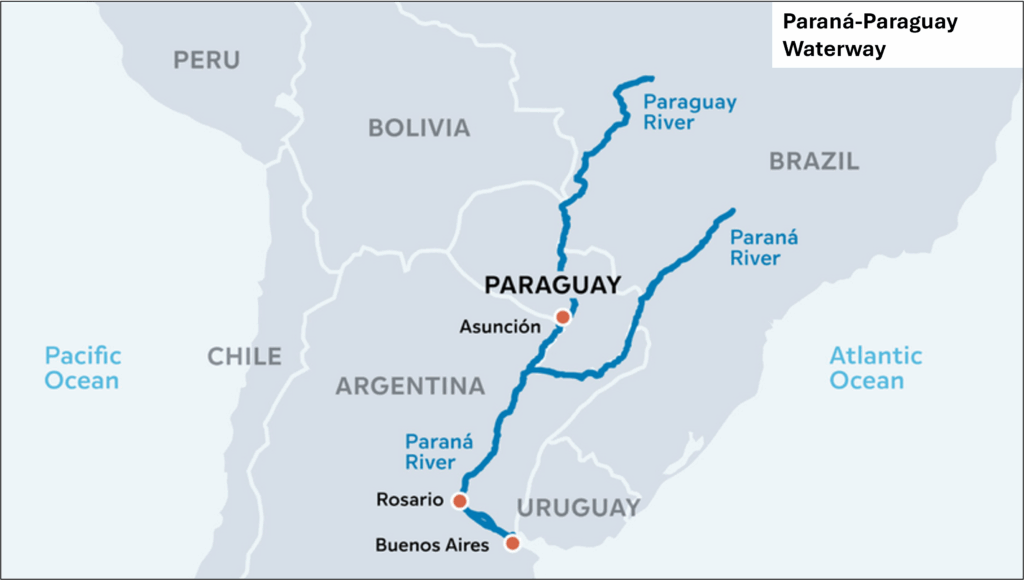
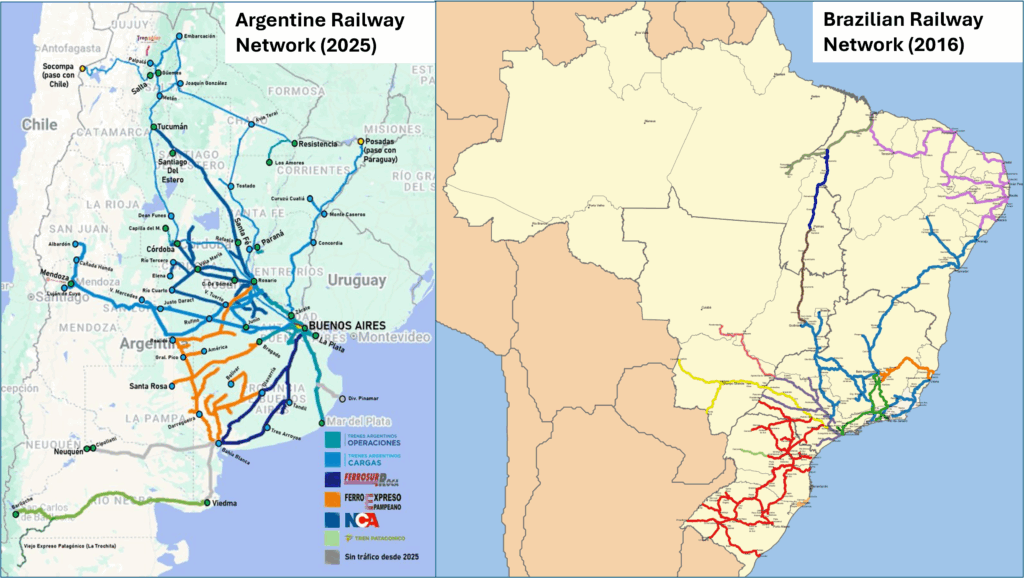
Geography, more than politics, determines regional gravity—and geography favours Argentina. Building roads or railways through the Brazilian tropical savanna is extremely expensive. Brazil’s long Atlantic coastline offers little continental connectivity. From São Paulo to Lima or Bogotá, the fastest and most efficient routes run through Argentina’s plains; the Amazon is more barrier than waterway. Instead, agricultural production flows naturally through the waterway toward Buenos Aires. Mining from the Andes can descend by train to river ports and then link to the Atlantic littoral or Patagonia.
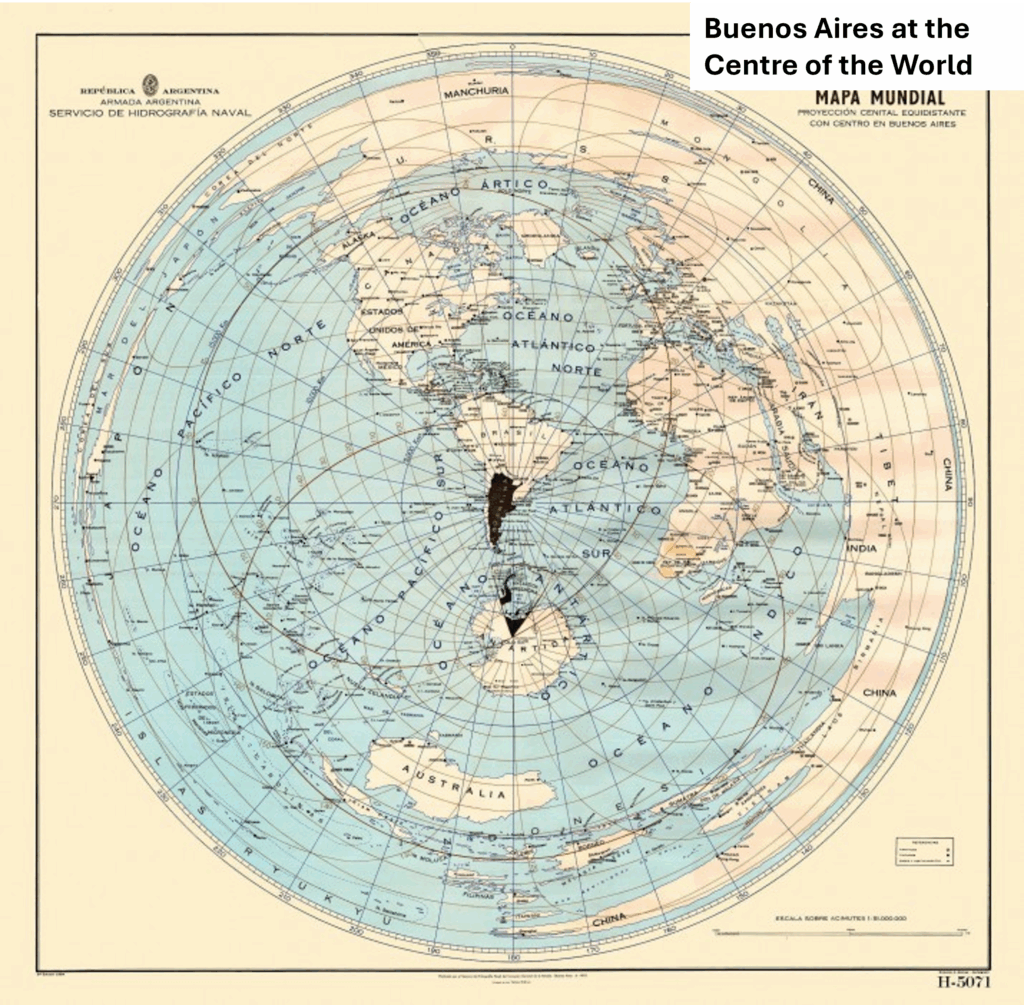
How “far away” is Argentina? Ushuaia, the world’s southernmost city, lies roughly 4,000 nautical miles from the Panama Canal—the same distance as Seattle. By comparison, the port of Santos, near Sao Paulo, is 4,600 nautical miles away. From Patagonia, both the Atlantic and Pacific are accessible; Panama is as distant as New Zealand or the Indian Ocean. Antarctica lies only 600 nautical miles to the south. This gives Argentina a unique maritime and polar strategic position in the hemisphere, controlling, with Chile, the only deep-water passage between the Atlantic and the Pacific.
Patagonia’s exceptional wind resources and Vaca Muerta’s vast gas reserves position Argentina to become the hemisphere’s most competitive energy hub. For American planners seeking to near-shore industries that can no longer depend on China, Argentina offers abundant energy, space for industrial clusters, fewer environmental blockages, and ports with direct access to the North Atlantic and close proximity to the Pacific.
Argentina also stands out in nuclear technology. It is one of the few countries outside the major powers capable of building a full civilian nuclear ecosystem—uranium mining, enrichment, and reactor design. Its Atomic Energy Commission pioneered SMR concepts in the 1980s and, after decades of research, now plans to build four 300 MW SMR reactors by the early 2030s. These could become the world’s first commercially viable SMRs. The units would likely be developed with U.S. investment and targeted to the American grid and industrial sector, positioning Argentina as a leading exporter of nuclear technology.
Cheap energy will serve as a powerful integrating force across the region, especially for Chile and the industrial south of Brazil.
Patagonia is poised to become a magnet for energy-intensive basic material industries such as petrochemicals, metallurgy, rare-earth separation, lithium-hydroxide refining, uranium processing, battery materials, and the production of ammonia and hydrogen. Ores from Chile, Peru and Argentina (copper), from Brazil and Australia (iron), lithium from Bolivia/Argentina/Chile, uranium and rare earths from Argentina could be refined or processed in Argentine ports such as Bahía Blanca or Puerto Madryn before heading to both U.S. coasts, Brazil or other global markets.
This directly supports U.S. nearshoring efforts under a renewed “Monroe Doctrine 2.0,” fostering deeper economic integration across the continent. It will also ease migration pressures on the United States, as Argentina is positioned to absorb not only capital but also labour that can integrate rapidly into its expanding economy.
Argentina is the safest country in the hemisphere after Canada. Unlike its neighbours, it lacks jungles or mountains near urban centres that shelter insurgents or cartels. From this position, Argentina can help stabilise its neighbours, disrupt trafficking routes, secure the Paraná–Paraguay river system and improve border control through intelligence cooperation.
This capability is explicitly desired by the United States under the “Enlist and Expand” framework.
Buenos Aires is the cultural capital of the Hispanic world. Its universities, theatres, music and intellectual life give it an influence comparable to New York or London within Latin America. Argentina has repeatedly acted as the region’s cultural trendsetter—from independence in 1810 to the democratic wave of the 1980s, and now the rise of libertarian and reformist politics under Milei.
As this change in mindset spreads, marked by a renewed commitment to deregulation and free trade, and a rejection of the corporatist import-substitution playbook, genuine South American integration becomes possible for the first time.
For the United States, a stronger Argentina offers clear benefits. It reduces China’s access to South American minerals, anchors refining and processing on friendly soil, provides a southern logistics partner as Antarctica grows in geopolitical importance, lowers migratory pressure through regional growth, and helps stabilise critical trade arteries such as the Paraná waterway.
Argentina, in turn, gains something it has lacked for decades: a clear geopolitical purpose, access to capital, and integration into global supply chains. If Milei or his successors maintain the reformist course, Argentina could emerge as the industrial and logistical anchor of the Southern Cone, an evolution with enormous political and economic dividends.
None of this is guaranteed. It will take decades to cement and Argentina remains volatile; its institutions are often fragile; its politics can shift abruptly. But the structural forces shaping this moment are stronger than any election cycle. While political consensus can be achieved, geography is not subject to ideology.