Physical Address
304 North Cardinal St.
Dorchester Center, MA 02124
Physical Address
304 North Cardinal St.
Dorchester Center, MA 02124


As a national brand to inspire enterprise, Argentina could hardly have been better named. The Silverland – a faraway country of extraordinary riches and boundless potential, as limitless as the vast plains of the Pampas.
Undeniably, Argentina is a paradox. There is a saying that it is “the country of missed opportunities.” Yet this is only partly true. Viewed through a longer historical timeframe, Argentina reveals moments of astonishing and unexpected transformation – periods when new ideas, new generations, renewed sets of elites abruptly reshaped its trajectory. These turning points have always arrived with conflict, uncertainty, and confusion, but also with renewal.
Silverland 5.0
The first Argentina was born as a greenfield project on the Spanish imperial map. In 1776, King Carlos III created the Viceroyalty of the Río de la Plata, choosing Buenos Aires, then a small frontier fort, as its capital. It was a geopolitical invention, conceived to defend Spanish South America from Portuguese encroachment and to control the flow of silver from Potosí (in present-day Bolivia) to Europe.
The second Argentina was made in the era of wars of independence: campaigns to Chile and Peru, struggles against foreign powers, internal conflicts, blockades, and the young nation’s first default.
The third Argentina was the liberal Republic starting in the mid-nineteenth century, integrated into the system of global commerce, welcoming mass immigration, expanding its frontier, building infrastructure and achieving spectacular growth. The granary of the world, it became the regional power.
The fourth Argentina began in 1930 – the corporatist Republic epitomised by Perón – dominated by state intervention, import substitution, autarky, recurrent military coups, chronic deficits, inflation and defaults.
The fifth Argentina may have just begun.
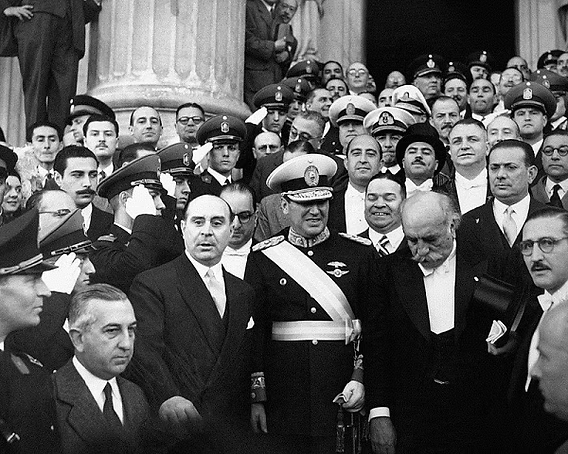
Juan Domingo Perón, 1946
Chainsawnomics
Javier Milei is the world’s first self-declared libertarian head of state. Despite commanding one of the smallest congressional blocs in Argentine history, his first two years in office produced results that would be remarkable under any circumstance: balanced the federal budget in his first month (shifting from a 5% deficit to a 0.5% surplus); reduced taxes by two percentage points of GDP; cut inflation from 25% to below 2% per month; loosened capital controls and trimmed government debt by roughly 10% in US dollars; more than 8,000 regulations were repealed, devolving power and widening economic freedom; introduced a simpler, more predictable tax framework designed to attract investment.
In 2023, when Milei took office, the economy was in free fall and on the brink of hyperinflation. One year later, after his austerity policies, the economy rebounded sharply, against every forecast, sending conventional macroeconomic wisdom to the dustbin.
Foreign alignment is equally striking: “With a Little Help from My Friends…”
Argentina has secured strong backing from the United States and the IMF to refinance its debt.
Milei’s clear alignment with Washington – and personal rapport with the current US administration – places Argentina in a strategically advantageous regional position. This relationship could restore preferential access to trade and capital flows, a situation not seen since the 1930s.
Yet, given the country’s historical volatility and internal political frictions, access to international capital markets remains limited for now. Investor confidence will hinge on the durability of fiscal stabilisation and the credibility of reform.
The Political Backdrop
Before Milei, Argentine politics revolved around personalities and social bases rather than divisions around ideas.
Peronism – neither a party nor an ideology but a “movement” – has long functioned as a political power machine: pragmatic, adaptable, and often contradictory. Over the decades it shifted from corporatist nationalism to centre-right populism to left-leaning statism, maintaining its cult of charismatic leadership and a near-religious hold over its base. During the Kirchner era, it aligned with the “21st-Century Socialism” of Chávez, Castro, and Lula da Silva.
The traditional opposition, the Unión Cívica Radical (UCR), began as a nineteenth-century liberal-populist force but gradually drifted toward social democracy. Supported mainly by the urban middle class but shared equally interventionist and redistributive instincts, it differed more in forms and its social base than in policy substance. As with Peronism, it favoured high public spending and protectionism and held a suspicion of markets.
In the mid-2000s, Mauricio Macri founded Pro, the first modern, pro-market centre-right party in decades. Yet PRO lacked national reach and was obliged to form an alliance with the social-democratic UCR to win the presidential race in 2015. United by the anti-Peronist feeling, at the end the alliance covered a bigger spectrum of ideas than Peronism itself. The alliance found it impossible to reach a consensus on decisive change. Macri’s administration failed to deliver, and majorities pivoted back to Peronism in 2019.
The “Cultural Battle” – A Generation Re-Educated
Milei’s La Libertad Avanza (LLA) shattered that pattern. A television economist turned political outsider, he built a cross-class, cross-regional movement, especially among younger voters disillusioned with the political class and years of stagnation.
Milei often describes his project as a “cultural battle” in defence of the “ideas of Liberty” based on moral principles rather than economic efficiency. The natural rights to Life, Property and Individual Freedom are the basis of prosperity and societal harmony. His political mission, therefore, extends beyond reforming institutions: it seeks first to ‘re-educate’ the society.
Since long before his election, Milei managed to persuade audiences through televised debates, university-style lectures, and an unfiltered presence on social media. His direct language, emotional and rich in images, resonates especially with young Argentines, who are now quoting Hayek and Rothbard as naturally as their parents once referenced Perón and Che Guevara.
Milei often describes his project as a “cultural battle” in defence of the “ideas of Liberty” based on moral principles rather than economic efficiency.
The Second-Generation Reforms
Argentina remains one of the world’s most closed economies – a net exporter of agricultural goods and importer of capital goods. Sustainable growth, however, requires greater openness to trade and investment.
For over a century, domestic business groups prospered under corporatism, protectionism, and political privilege rather than competition. Each timid attempt at liberalisation triggered a crisis. The State, industrial groups, unions, media, lawyers and other professions together form a dense web defending the status quo.
Milei’s “second-generation reforms” directly challenge this ecosystem. They seek to reduce labour, tax, financial, regulatory, and infrastructure costs, through a phased sequence:
The discomfort experienced over the last months signals not failure but a system in the process of reset. The recent success in the ballots should help calm the nerves.
The New Congress
In 2023 Milei was elected President with 56% of the vote in the second round of voting.
During his first year – with only 15% of seats in the lower house and 8% in the Senate – Milei passed major reforms through negotiation with the softer opposition (centre-left non-Peronist). His second year proved harder: as mid-term elections approached, the opposition misread the social climate and instinctively got harder. Congress blocked new bills and pressed for higher social spending, threatening fiscal discipline.
On October 26th La Libertad Avanza won the mid-term elections in a remarkable fashion, with 41% of the votes nationally and achieving first place in 15 out of 24 provinces. Peronism has been reduced to its minimum expression ever in both chambers, assuming it stays united. Just as importantly, it dramatically purged the Congress from most “middle ground” social-democratic elements and provincial parties.
The new Congress changes the arithmetic:
Peronism is now leaderless and fragmented; its main figures are discredited or facing legal trouble. The contradictions within Peronism will now be impossible to hide. It is hard to imagine how they can reinvent themselves and stay even loosely united.
Governing Without a Majority
Can Milei achieve reform without outright congressional majorities? It should be possible.
Roughly a third of Congress is filled by Peronist factions. Yet Peronism is divided and demoralized – its leading figures are polarizing or discredited. Roughly two thirds of Peronists will oppose Milei unconditionally. However, Peronism is a pragmatic movement, far left elements are alien to the more conservative strands from the interior provinces. Some may soften their stance, aligning with a pro-growth agenda that better serves their constituencies’ interests.
His direct language […] resonates especially with young Argentines, who are now quoting Hayek and Rothbard as naturally as their parents once referenced Perón and Che Guevara.
The other independent provincial parties and remnants of the UCR will be poised to provide the additional votes needed for Milei’s ambitious reforms. If something has been demonstrated in the recent elections, it is that opposing the government while seducing the centrist voter is impossible.
Why hasn’t this logic worked in the past? There are 3 differences with the Macri experiment:
As in the mid-1850s, ideas matter – but to help align interests, nothing is better than business…
Economic Drivers for the Decade Ahead
Unlike the 1990s – when reform lacked external engines – Argentina now has multiple potential growth drivers across a wide range of sectors, emerging simultaneously:

“…dwelling on what lies in the rear-view mirror is no longer an option.”
What can go wrong?
Argentina’s greatest risk is also its most fascinating advantage. Why has the country so often drifted into isolation? The answer is simple: because it can afford to. Argentina can be remarkably self-sufficient for long periods of time. While most economies would collapse under such strain, Argentina does not. It can bleed almost to death – consuming its own capital – and only then does it feel compelled to change.
And because Argentines are passionate by nature, they fervently embrace ideas, right or wrong. Liberty is embraced with passion, reinterpreted differently each generation. The gaucho was a free lonely wanderer of the Pampas; the elites of Buenos Aires fought for independence from Spain and foreign powers; the interior provinces sought autonomy from Buenos Aires; Peron led Argentina to autarchy vociferating for freedom from foreign capital…
Milei redefines liberty once again: freedom from State oppression, echoing the nineteenth-century liberal tradition. It resonates with a generation weary of social decay and inaccessible privilege. Whether this tide endures will depend on whether institutions can anchor it.
The United States may now play the pivotal role once held by Great Britain in the nineteenth century. A conscious alliance built on shared values and mutual interests – trade integration, strategic cooperation, and capital flows – could provide the external anchor Argentina has lacked since the 1930s. Voluntary dollarisation, if achieved, could cement that bond. The sacred rule must remain: “not even one drop” of fiscal deficit.
Mulligan — A Second Chance
Is Argentina being offered a second chance? It may not be the country of missed opportunities after all. The path ahead remains uncertain and strewn with obstacles, yet dwelling on what lies in the rear-view mirror is no longer an option.
Whether President Milei’s libertarian experiment succeeds will depend not only on his ability to consolidate alliances, maintain fiscal discipline, and unleash long-suppressed productive forces, but – more decisively – on a generational change of mentality already taking root.
For the first time in generations, the conditions for a structural economic take-off appear within reach. If Argentina seizes this moment, the fifth Argentina – Silverland 5.0 – could mark not merely another cycle, but a durable road to prosperity, fulfilling at last the promise that has so often eluded it.

Comments are closed.





hello fantastic
Thanks
Excellent Article